

In 1883, the Canadian Pacific Railway extended its track from Medicine Hat to Calgary. In addition, the railway acquired 3.5 million acres of land between Brooks and Calgary as part of an agreement with the Dominion government to build a new line. The lands along these railway lines became suitable for farming.
In 1884, the railway began selling land to farmers who emigrated to Canada. Much of the land, however, lacked sufficient water supply. A large-scale irrigation project near the Bow River was undertaken to make the land fit for agriculture. More details are available on edmonton.name.
Construction of the Alberta Wheat Pool Elevator
The irrigation project was completed in 1914. With the onset of the war in Europe, settlers began to arrive in Alberta. The largest influx occurred in 1920, when the Canadian Pacific Railway laid lines across much of the region. One of these lines extended south from Brooks to the village of Scandia.
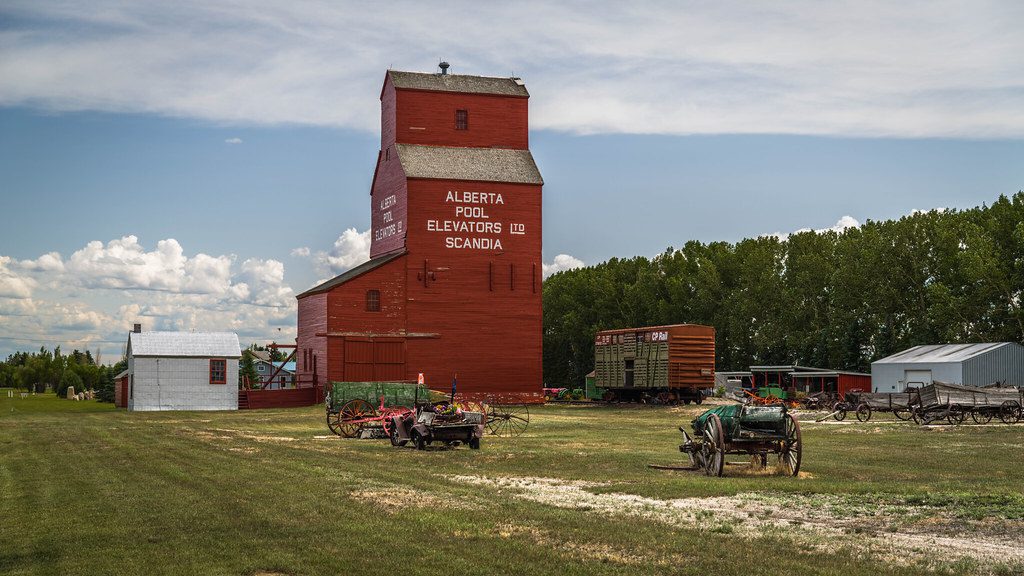
In 1928, thanks to the farmers’ cooperative efforts, the Alberta Wheat Pool elevator was built in the village. At that time, a cooperative movement among farmers in Alberta was gaining momentum. The movement was founded by Henry Wise Wood. Farmers across the province were frustrated by the control independent grain companies held over prices, which they set arbitrarily. As a result, sharp fluctuations in international demand for grain often drove farmers from success to bankruptcy in short periods.
Wood believed that farmers needed to create their own cooperative, which would allow them to pool their grain, sell it at the most advantageous time, and share the profits among themselves.
He convinced others, and when the elevator was built, Henry Wise Wood became its first manager. Soon, Alberta Wheat Pool elevators were being constructed in most farming communities with railway access. Over time, Wood’s cooperative became the largest grain company in the province.
The Alberta Wheat Pool elevator was constructed from wood. It could process 100 tons of grain per hour. Its elevator pit could hold approximately 10 tons of grain.
Farmers’ Resistance
It was fitting that the first elevator in Scandia belonged to the Alberta Wheat Pool, as the farmers of the region had already united against the railway due to shared grievances. The railway sold them their land, yet they were forced to pay high prices for water while enduring low and unstable profits.
Although Scandia’s grain yield was high, the 80 acres allotted per farm were insufficient, causing profitability to decline. Farmers’ frustration led to the formation of more associations aimed at challenging the railway. Eventually, in 1934, under the leadership of Carl Anderson, farmers established the Eastern Irrigation District, taking over the water supply management from the Canadian Pacific Railway. Despite its high cost, the irrigation water proved beneficial during drought years when other parts of Alberta suffered.
The productivity of the land around Scandia remained high. In 1937, the Federal Grain Company built another elevator in the village. During World War II, the demand for Canadian grain increased, and train service to Scandia operated three times a week.
After the war, Alberta Wheat Pool purchased the Federal Grain Company’s elevator and soon shut it down. Improvements to local roads made it easier for farmers to transport their grain to Brooks. As a result, the elevator in Scandia was closed in 1977.
Preserving History
Several years later, the old elevator was transferred to the District Historical Park and Museum, becoming the central feature of an agricultural museum. In 2008, it was designated a Provincial Historic Resource, recognizing its importance in Alberta’s farming and cooperative history.